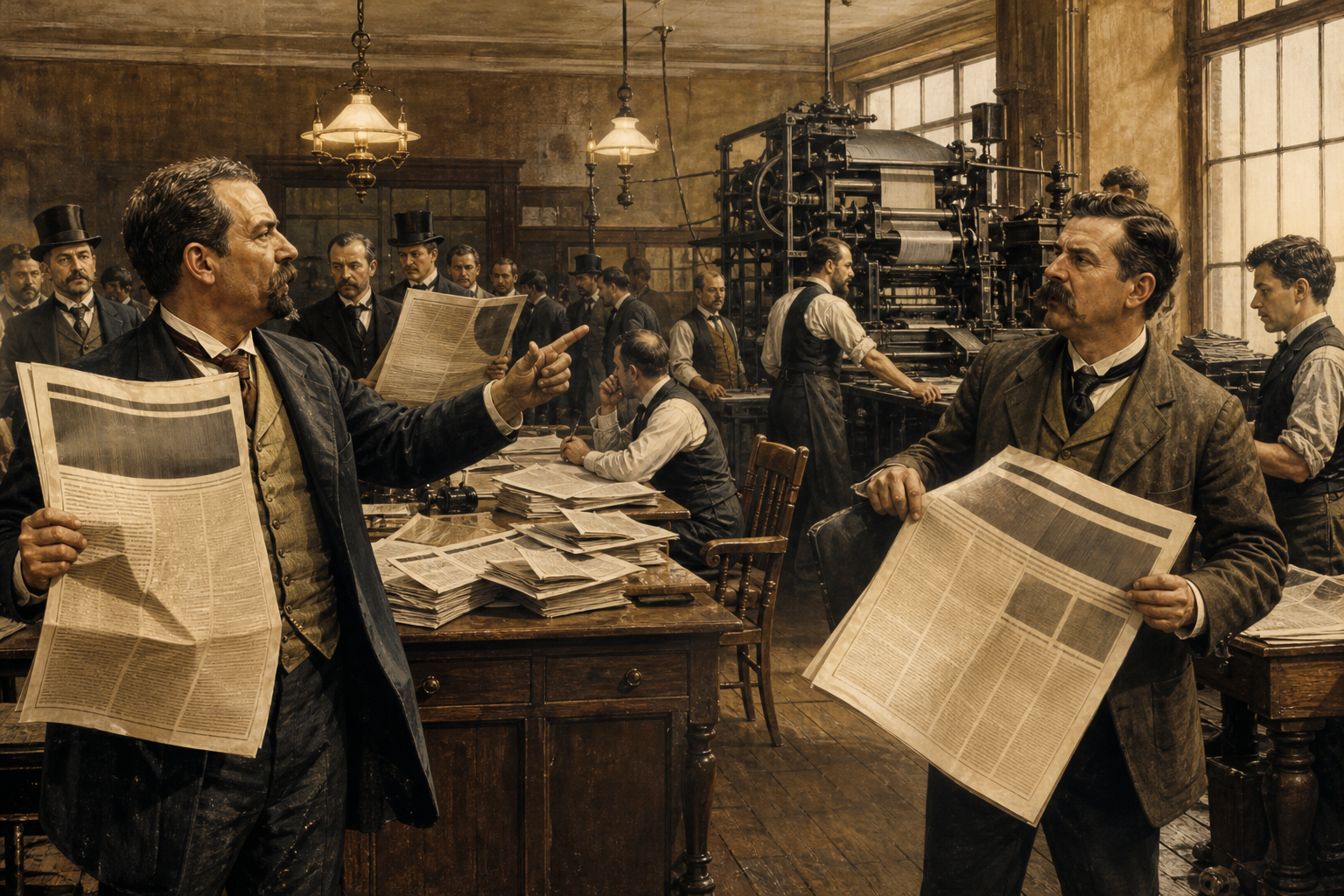
The yellow journalism definition us history readers often need is straightforward: it describes a style of newspaper reporting that uses sensational headlines, dramatic language, eye-catching images and sometimes exaggerated or weakly verified claims to attract a large audience. In the United States, the phrase emerged during fierce newspaper competition in New York City in the 1890s. Its story helps explain how commercial pressure, popular culture and political reporting became closely connected.
Yellow journalism was not simply a synonym for every inaccurate story. It referred to a recognisable form of mass-market newspaper publishing, shaped by new printing technology, growing urban readerships and publishers who competed for attention. Understanding that distinction makes the term more useful when studying both American history and modern media.
yellow journalism definition us history: What the term means
In historical context, yellow journalism means news coverage designed to maximise public interest, often by placing emotion and spectacle ahead of restraint. Common features included sensational headlines, lurid descriptions of crime, dramatic illustrations, simplified political narratives and stories presented with more confidence than the available evidence justified.
The word “yellow” came from The Yellow Kid, a popular cartoon character created by artist Richard F. Outcault. The character appeared in colour in Joseph Pulitzer’s New York World and later became associated with William Randolph Hearst’s New York Journal after a dispute over the artist’s work. The rivalry surrounding the cartoon helped give the new style of popular newspaper publishing its name.
That origin matters because the label initially described more than irresponsible reporting. These newspapers also used innovations that made them accessible and attractive: large illustrations, colour printing, lively layouts, short articles and coverage of subjects that appealed to working-class and immigrant readers. The same publications could combine genuine reporting with theatrical presentation and sensational treatment.
Why newspapers competed so aggressively
Several changes made the 1890s especially important. Urban populations were expanding, literacy was rising and cheaper printing allowed newspapers to reach far more people. Publishers increasingly relied on high circulation and advertising revenue rather than a small elite readership. A striking front page could therefore have direct commercial value.
New York was a particularly competitive market. Pulitzer’s World had built a large audience with accessible language and visually bold presentation. Hearst’s Journal challenged it with similarly attention-grabbing tactics. Their rivalry encouraged bigger headlines, more dramatic stories and a willingness to treat news as a form of entertainment as well as public information.
Yellow journalism in US history: The Spanish-American War debate
Yellow journalism is often discussed alongside the Spanish-American War of 1898. American newspapers published highly emotional accounts of Spanish rule in Cuba and gave extensive coverage to events such as the explosion of the USS Maine in Havana harbour. Some headlines and reports presented Spanish responsibility as obvious before investigators had established what had happened.
These stories helped intensify public feeling, but historians continue to debate how much influence newspapers had on the decision to go to war. It would be too simple to claim that yellow journalism alone caused the conflict. Political interests, humanitarian concerns, Cuban resistance to Spanish rule, strategic considerations and public opinion all played roles. Newspaper sensationalism was one part of a much wider political and international situation.
This is an important historical lesson: media can shape the atmosphere in which decisions are made without being the only cause of those decisions. A newspaper may amplify fear or anger, influence which events receive attention and pressure politicians, while still operating within a larger network of institutions and public debates.
What made the coverage sensational?
- Emotional framing: Stories presented complex international events as a simple struggle between innocent victims and cruel villains.
- Striking presentation: Large headlines, illustrations and dramatic page layouts competed for readers’ attention.
- Selective emphasis: Violent or shocking incidents received more space than quieter evidence and competing interpretations.
- Uncertain verification: Reports from distant locations could be difficult to check, creating room for rumours and exaggeration.
Not every report in a sensational newspaper was false, and not every conventional newspaper was reliable. The historical value of the term lies in identifying a pattern of presentation and competition, not in sorting all journalism into two perfect categories.
How yellow journalism changed American news culture
The rise of yellow journalism helped establish several features of modern mass media. Newspapers learned that design, narrative and emotional appeal could be as important to circulation as the factual subject itself. Crime, celebrity, scandal, disasters and international conflict became regular parts of a competitive attention economy.
It also contributed to a broader debate about the responsibilities of the press. If newspapers could influence public opinion through exaggeration, what standards should editors follow? How should a publication separate verified reporting from rumour? When does a forceful headline become misleading? These questions remain central to journalism, even though the technology has changed.
For a useful comparison, the wider meaning and modern examples of yellow journalism show how the term has moved beyond its nineteenth-century newspaper origins. Today, people may use it to describe sensational television coverage, click-driven websites, viral posts or political commentary that prioritises outrage over context.
Yellow journalism and the modern attention economy
Modern media does not reproduce the 1890s exactly. Digital publishing operates through social platforms, search engines, notifications and personalised feeds rather than only printed editions. However, the underlying incentive can look familiar: content that provokes a fast emotional response is often more likely to be clicked, shared or discussed.
A modern headline is not automatically yellow journalism because it is concise or attention-grabbing. The stronger test is whether it distorts the underlying story. Does it make a claim the article cannot support? Does it remove important context? Does it present an unverified allegation as fact? Does it use fear or anger to discourage careful reading?
Readers can also use practical habits to resist sensational coverage. Check whether a claim is supported by named evidence, compare several reputable outlets, look for the original document or statement and distinguish reporting from commentary. It is also worth reading beyond the headline. Clear news writing often gives the most important verified information early, a structure explained in this guide to the inverted pyramid style of journalism.
How to recognise yellow journalism today
The historical label is most useful when applied carefully. Consider these warning signs:
- A headline promises a shocking revelation but provides little specific evidence.
- The story relies on unnamed claims without explaining why anonymity was necessary.
- Images or video are presented without dates, locations or relevant context.
- A complicated event is reduced to a single villain, cause or explanation.
- Words such as “proof,” “disaster” or “explosive” appear to create urgency rather than clarify facts.
- The article encourages immediate outrage while offering no meaningful way to verify its claims.
These signs do not prove that a story is false. They indicate that readers should slow down and investigate further. Journalism can be vivid and accessible without abandoning accuracy, and strong reporting can acknowledge uncertainty instead of hiding it.
Why the history of yellow journalism still matters
The history of yellow journalism shows that concerns about sensational news did not begin with social media. More than a century ago, publishers were already testing how far headlines, images and emotional narratives could go in the pursuit of attention. The technology changed, but the tension between public service and commercial pressure remained.
Studying the term also prevents overly simple judgments about the past. The newspapers associated with yellow journalism expanded access to news and developed engaging forms of presentation, yet they could also encourage exaggeration and prejudice. Their legacy is therefore mixed: they helped create modern mass communication while revealing the risks of treating information primarily as a product.
That balance is still relevant as newsrooms use digital tools and artificial intelligence. Discussion of AI in journalism and public trust raises a related question: how can publishers gain speed and reach without weakening verification? The answer begins with the same principles that yellow journalism made impossible to ignore—accuracy, context, transparency and accountability.
In short, the yellow journalism definition in US history is not merely “fake news.” It describes a commercially driven, sensational style that emerged from late nineteenth-century newspaper rivalry. Its influence can be seen in the design of news, the politics of attention and the continuing need for readers to question stories that are designed to provoke before they inform. For a concise historical overview, see the Wikipedia entry on yellow journalism.





[…] yellow journalism definition us history: Origins, Examples and Influence […]